The Contourograph - a device for the real time display of VectorCardiograms
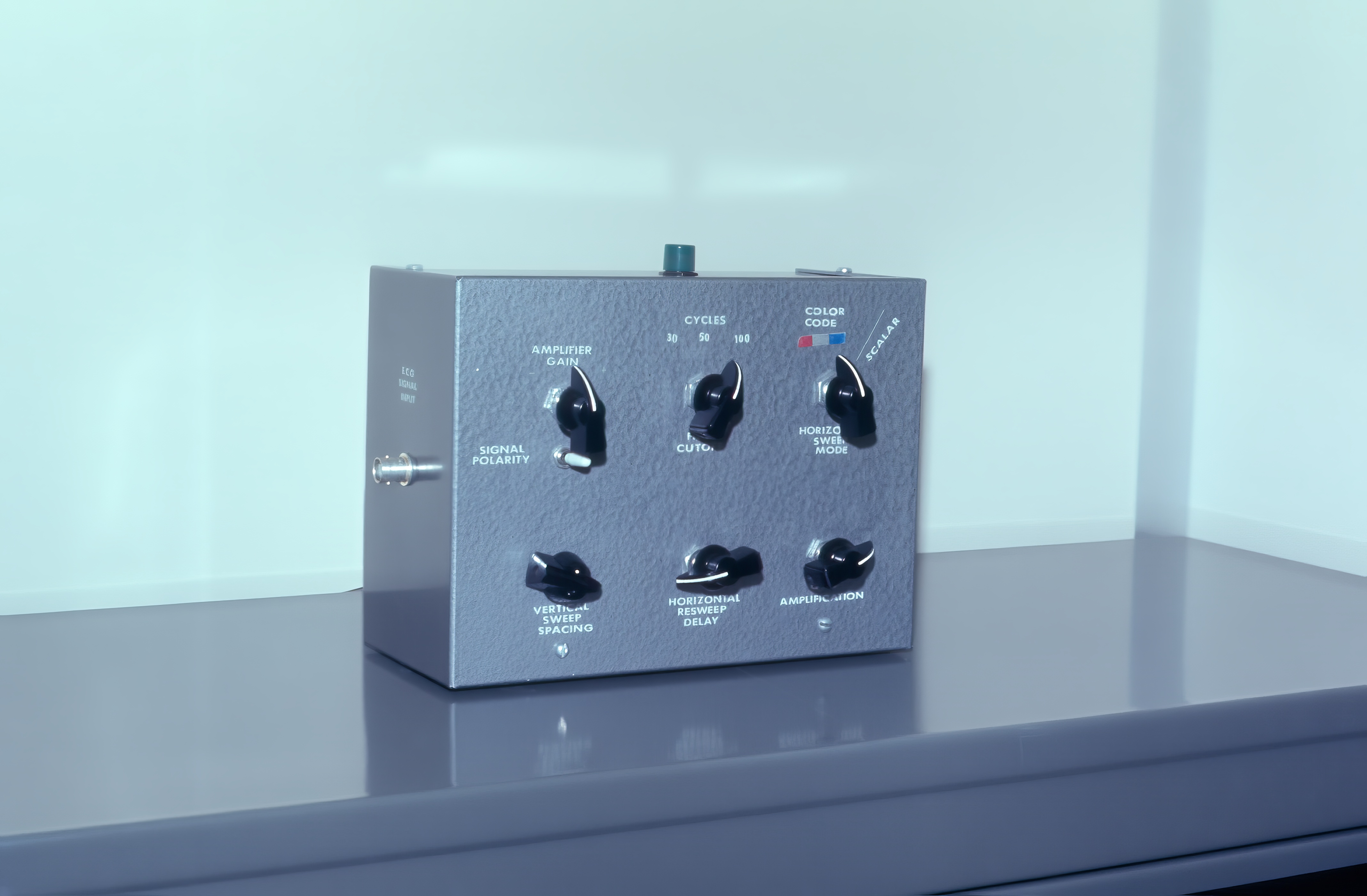
In the early 1970s, I was working as a contractor to NASA through Technology, Inc., supporting the medical monitoring operations that would be central to the Skylab program. One of the challenges facing the flight surgeons in Mission Control was how to watch an astronaut’s heart activity in a way that made changes over a time interval of about a minute or so immediately visible — not cycle by cycle, but as a continuous, evolving picture.
The device I helped develop to meet that need was called the Contourograph.
Monitoring a heart in real time is straightforward enough in a quiet clinical setting. But in Mission Control, flight surgeons needed to track vectorcardiogram (VCG) signals — three-dimensional electrical traces of the heart’s activity — during exercise protocols and LBNP (elsewhere in this site) intervals.
A traditional ECG/VCG on a pink paper strip chart is not adequate to see smalll cycle changes over time. We wanted to enable the flight surgeons to see the pattern, not just the moment.
The Contourograph solved this by displaying the electrocardiogram as a contourogram on a variable-persistence oscilloscope — a special type of screen that could hold a fading image of previous traces. Each new cardiac cycle was stacked below the one before it, building up a cascading, three-dimensional picture of the heart’s electrical activity over time. As the pattern flowed down the page the older traces faded from the display. When the pattern reached the bottom of the screen we had it do a retrace to the top.
Our MD’s loved it.
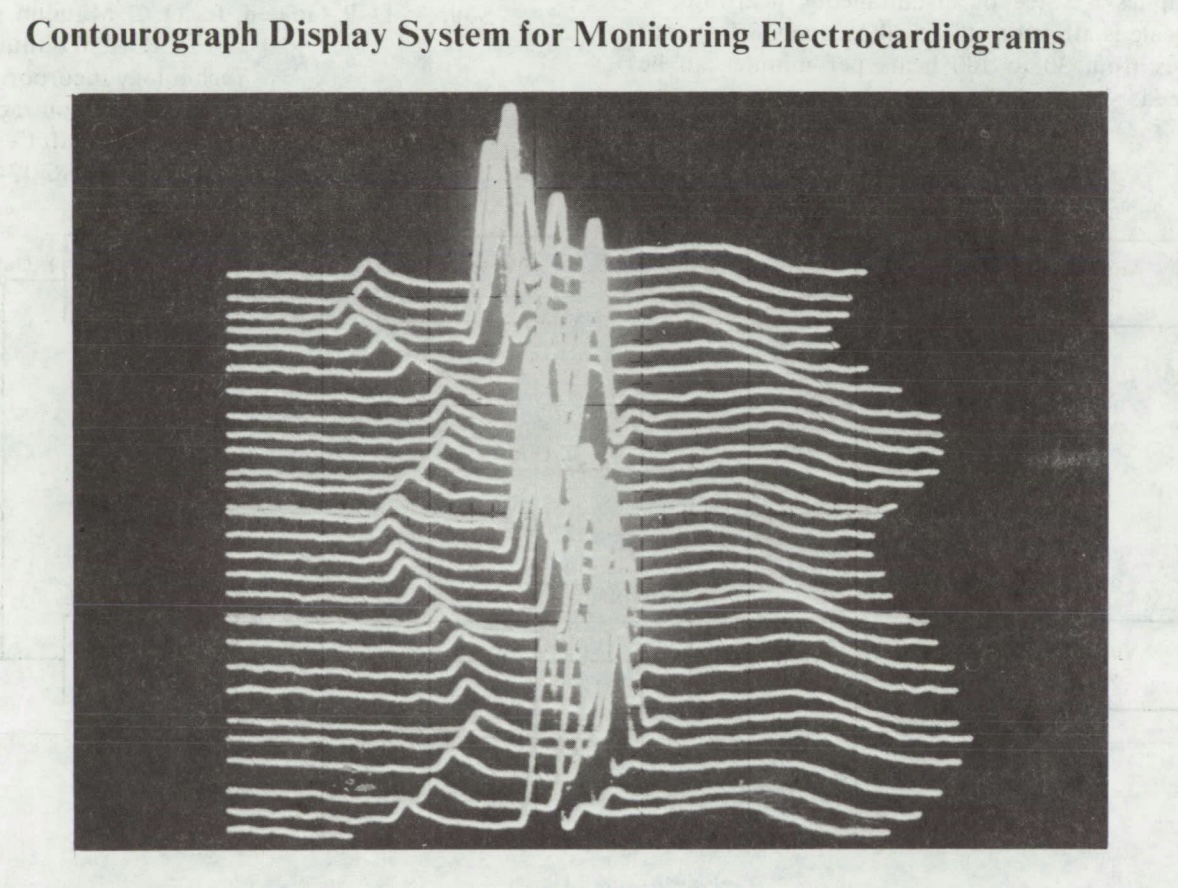
{Yeah, Yeah I know. Diaplay should have been a possessive in that caption.}
The effect was striking: instead of a single waveform on a screen, you saw a layered ribbon of signals, each slightly below and behind its predecessor. A normal heart produced a smooth, consistent cascade. Any significant change in rhythm, amplitude, or shape showed up immediately as a disruption in the pattern — visible at a glance, even from across a room.
Don Mauldin and I started this work just about the time we graduated from Rice and transitioned from part time to full time with TI. Don and really enjoyed working together, soldering up the prototypes, and testing. I recall Don’s statement that we are going ton need a ‘honking cap-a-cit-erator’ to get that much time delay.
The Contourograph was assigned NASA report number MSC-13407 and published as a NASA Tech Brief in October 1970. I was listed as lead author on the report, alongside Don and Roger. Roger definitely contributed but Don and I were the two guys with the soldering irons.
Skylab flew three crewed missions between 1973 and 1974.
During the Skylab missions the Contoutograph was in the room for the flight surgeons to adjacent to the big Mission Operation Control Room. The guys in this room were the support staff for the duty flight surgeon who was at a console in the MOCR.
Because I was an inventor I was allowed in this room just a few times during live missions. Getting into that complex. During a live mission was much harder than getting into someplace like the White House. Watching it display VCG’s from my astronaut buddies telemetered in real time as they performed their LBNP and Bicycle Ergometer protocols was a real treat.
NASA decided to apply for a patent as shown below. While Don and I are on the patent by our employment agreements we have no residual rights to the intellectual property. We were given bonuses of around $75 when the application was filed and a whopping $300 when it was granted. Why do I say whopping? In those days that was three months of car payments or rent.
US Patent 3,638,066 “Contourograph System for Monitoring Electrocardiograms”
- Filed: August 21, 1970
- Granted: January 25, 1972
- Application No.: 65,840
- Inventors: Thomas O. Paine (NASA Administrator, listed formally as assignee placeholder per NASA Act); Donald P. Golden, Jr., Webster, TX; Donald G. Mauldin, Houston, TX; Roger A. Wolthuts, Seabrook, TX
- Claims: 5 claims covering the triggering system, variable persistence display, sweep speed modes, signal filtering, and QRS detection
- Cited by: 12 subsequent patents, including Schlumberger, GE Medical Systems, Tektronix, and Biosense Webster — your invention has been cited in medical and industrial electronics patents for over 50 years
One interesting note: Thomas O. Paine (the NASA Administrator at the time) appears as a named inventor in the formal patent header — this was standard NASA legal practice under the Space Act, where the Administrator was listed to establish federal interest, while you and your colleagues were the actual inventors of record.
Leave a Memory or Comment
Have a story to add or something to say about this one? Don would love to hear it.